


1. Background
2. Objectives
3. Methods
3.1. Plant
3.2. Chemicals
3.3. Instruments
3.4. Animals
3.5. Extraction
3.6. Determination of Curcuminoid Quantitatively
3.7. Determination of Chemical Substances Using Gas Chromatography-Mass Spectra
3.8. Determination of Total Phenol
3.9. Determination of Total Flavonoid Content
3.10. Hepatoprotective Activity of Curcuma heyneana
| Groups | Treatments |
|---|---|
| Group 1 (negative control) | The rats were administered 0.5% carboxymethyl cellulose (suspending agent of extract) orally once a day for 7 days. |
| Group 2 | The rats were administered extract dose of 50 mg/kg BW orally once a day for 7 days. |
| Group 3 | The rats were administered extract dose of 100 mg/kg BW orally once a day for 7 days. |
| Group 4 | The rats were administered extract dose of 150 mg/kg BW orally once a day for 7 days. |
| Group 5 (positive control) | The rats were administered catechin dose of 150 mg/kg BW orally once a day for 7 days. |
| Group 6 (normal control) | The rats were given food and water freely for 7 days. |
3.11. Determination of Macroscopic Liver
3.12. Determination of Microscopic Liver
4. Results
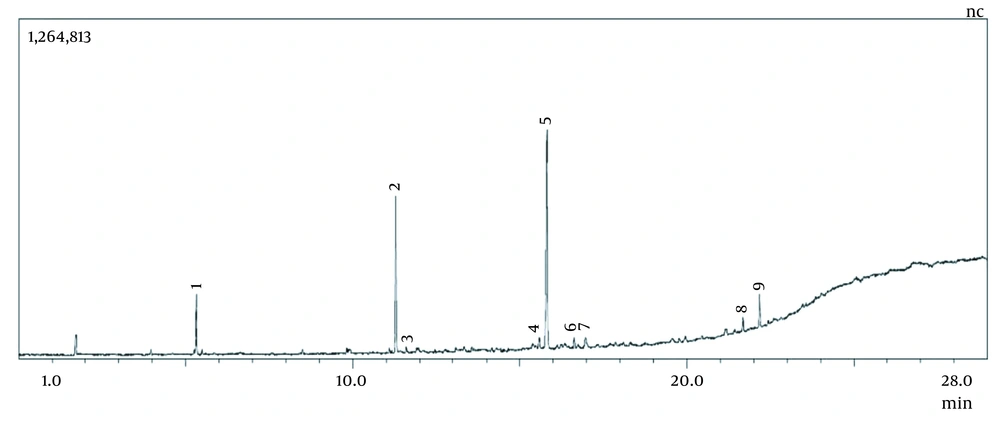
The chemical substances detected with gas chromatography-mass spectra
-preview.webp "Peak, retention time (minute), area (%), identified ions (m/z), similarity index, and formula of the chemical substances detected with gas chromatography -mass spectra (*library: WILEY7.LIB).")
Peak, retention time (minute), area (%), identified ions (m/z), similarity index, and formula of the chemical substances detected with gas chromatography -mass spectra (*library: WILEY7.LIB).
4.1. Total Phenolic Content
-preview.webp "Regression of gallic acid")
Regression of gallic acid
| Sample Number | Sample Weight (g) | Absorbance | Total Phenolic Content (mg GAE/g Sample) |
|---|---|---|---|
| Curcuma heyneana extract | |||
| 1 | 0.051 | 0.6611 | 401.61 |
| 2 | 0.053 | 0.6609 | 386.83 |
| 3 | 0.054 | 0.6622 | 412.63 |
| Average | 400.37 | ||
| Quercetin | |||
| 1 | 0.025 | 0.5156 | 630.6 |
| 2 | 0.025 | 0.7167 | 891.4 |
| 3 | 0.025 | 0.7306 | 909.5 |
| Average | 810.5 |
4.2. Total Flavonoid Content
| Sample Number | Sample Weight (g) | Average of Absorbance | Total Flavonoid Content (mg QR/g Sample) |
|---|---|---|---|
| 1 | 0.02514 | 0.6036 | 27.34 |
| 2 | 0.02509 | 0.5787 | 26.26 |
| 3 | 0.02513 | 0.6214 | 28.15 |
| Average of total flavonoid content | 27.25 |
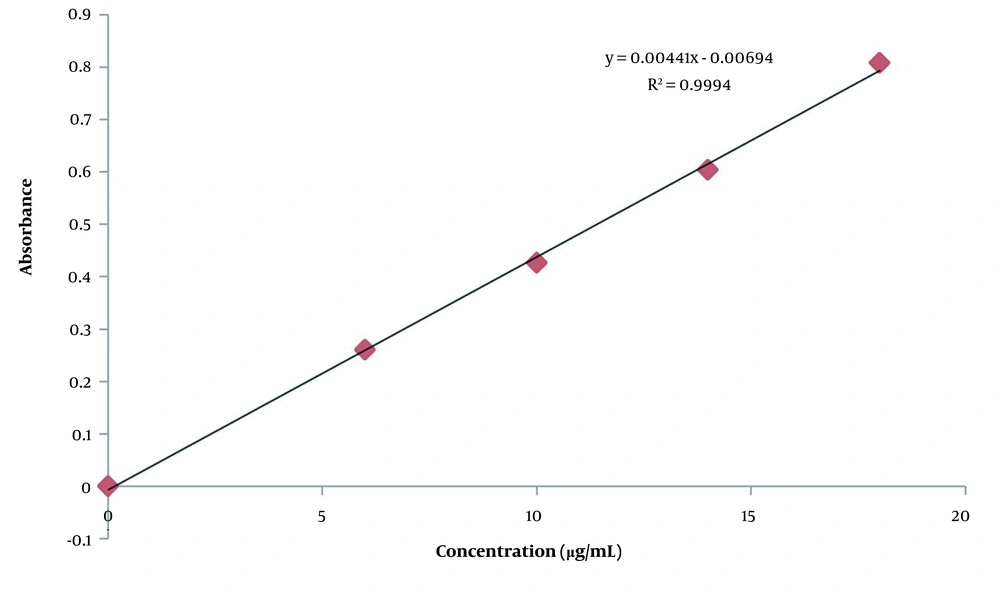
Regression of quercetin
4.3. Hepatoprotective Activity
4.3.1. The Relative Organ Weight
| Groups | Relative Organ Weight (%) ± SE | ALT Level (IU/L) ± SE | AST Level (IU/L) ± SE |
|---|---|---|---|
| Negative control | 3.65 ± 0.20 | 140.0 ± 12.33 a | 351.0 ± 48.22 a |
| Extract dose of 50 mg/kg | 3.60 ± 0.14 | 94.0 ± 7.10 b | 173.4 ± 7.78 b |
| Extract dose of 100 mg/kg | 3.58 ± 0.10 | 91.6 ± 10.09 b | 167.4 ± 8.38 b |
| Extract dose of 150 mg/kg | 3.40 ± 0.11 | 85.2 ± 5.83 b | 164.2 ± 11.96 b |
| Positive control (Catechin) | 3.36 ± 0.24 | 83.4 ± 2.87 b | 158.0 ± 11.83 b |
| Normal control | 3.29 ± 0.06 | 75.5 ± 4.05 | 149.4 ± 11.12 |
a Significantly different from the normal control group (P < 0.05).
b Significantly different from the negative control group (P < 0.05).
4.3.2. Macroscopic Findings of Liver
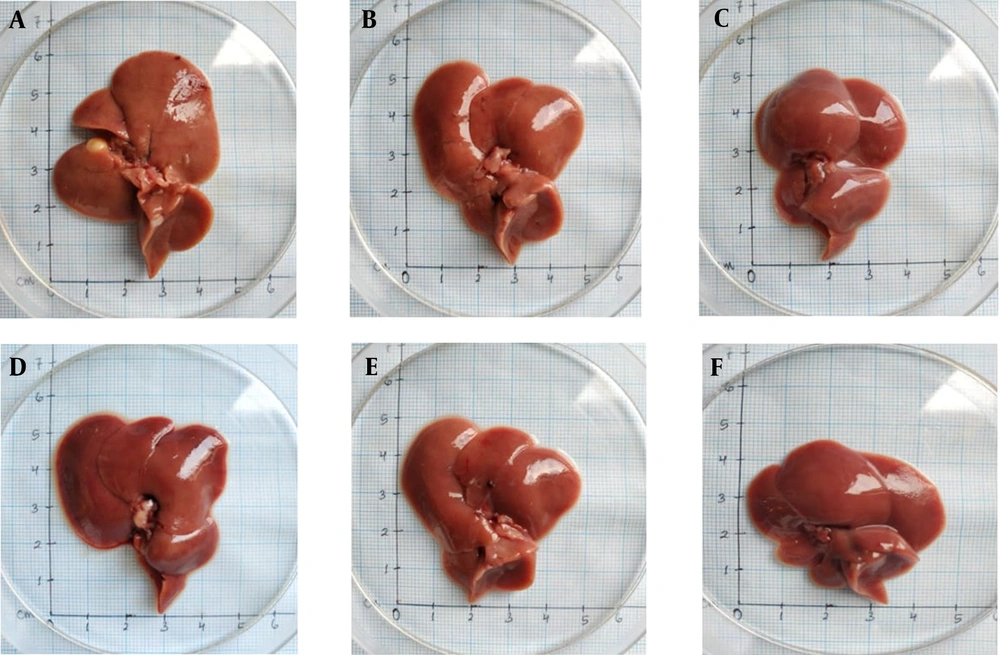
Macroscopic findings of rats’ livers: A, negative control; B, extract dose of 50 mg/kg; C, extract dose of 100 mg/kg; D, extract dose of 150 mg/kg; e, catechin; f, normal control.
4.3.3. ALT and AST Levels
4.3.4. Microscopic Findings of Liver
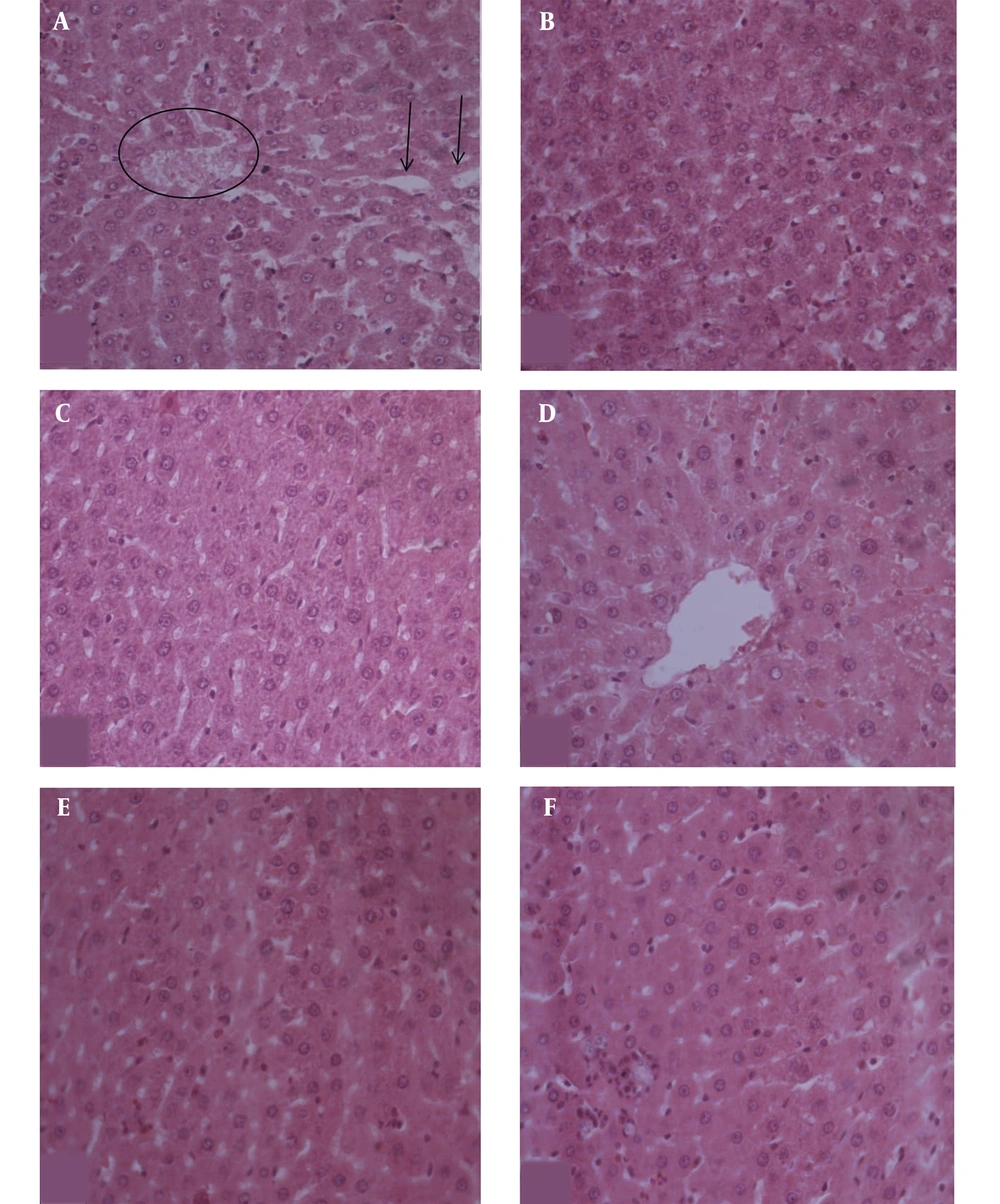
Microscopic findings of the liver with a magnification of 40 × 10. A, negative control; B, a dose of 50 mg/kg; C, a dose of 100 mg/kg; D, a dose of 150 mg/kg; E, positive control; F, normal control


